
Bookshelf Plans
A bookshelf is a classic first woodworking project, and most failures come down to two things: shelves that sag under the weight of books, and parts cut to the wrong size. This calculator turns your chosen dimensions into a cut list, checks each shelf’s sag for the material and span you choose, and estimates how much lumber or plywood to buy.
- Free to use
- No sign-up
- Runs in your browser
Bookshelf plans calculator
Bookshelf Plans Pack
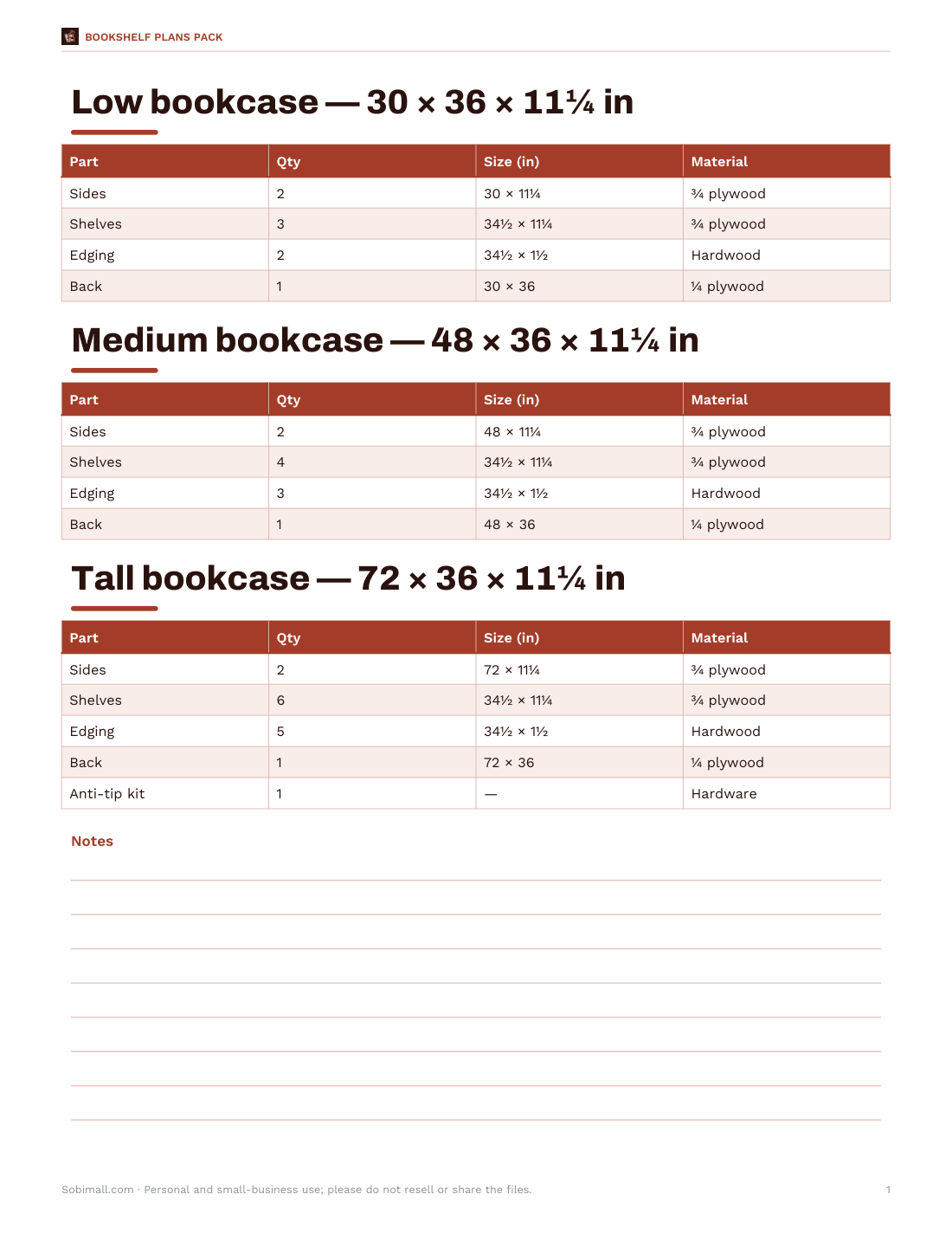
Printable plans for three bookcases with cut lists, a shelf span and sag reference chart, a build checklist and an Excel cut list calculator.
- Three bookcase plans (PDF)
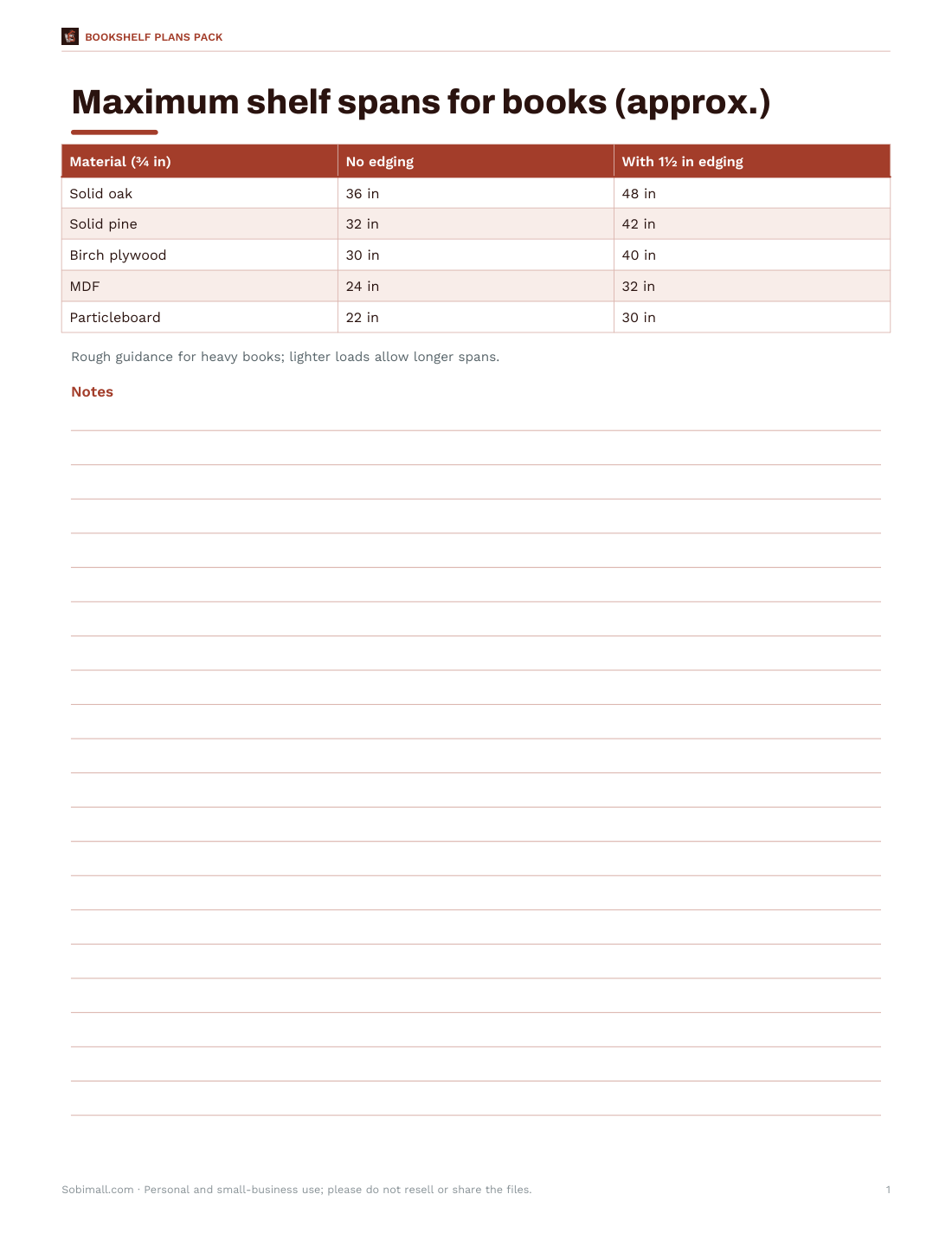
- Span chart (PDF)
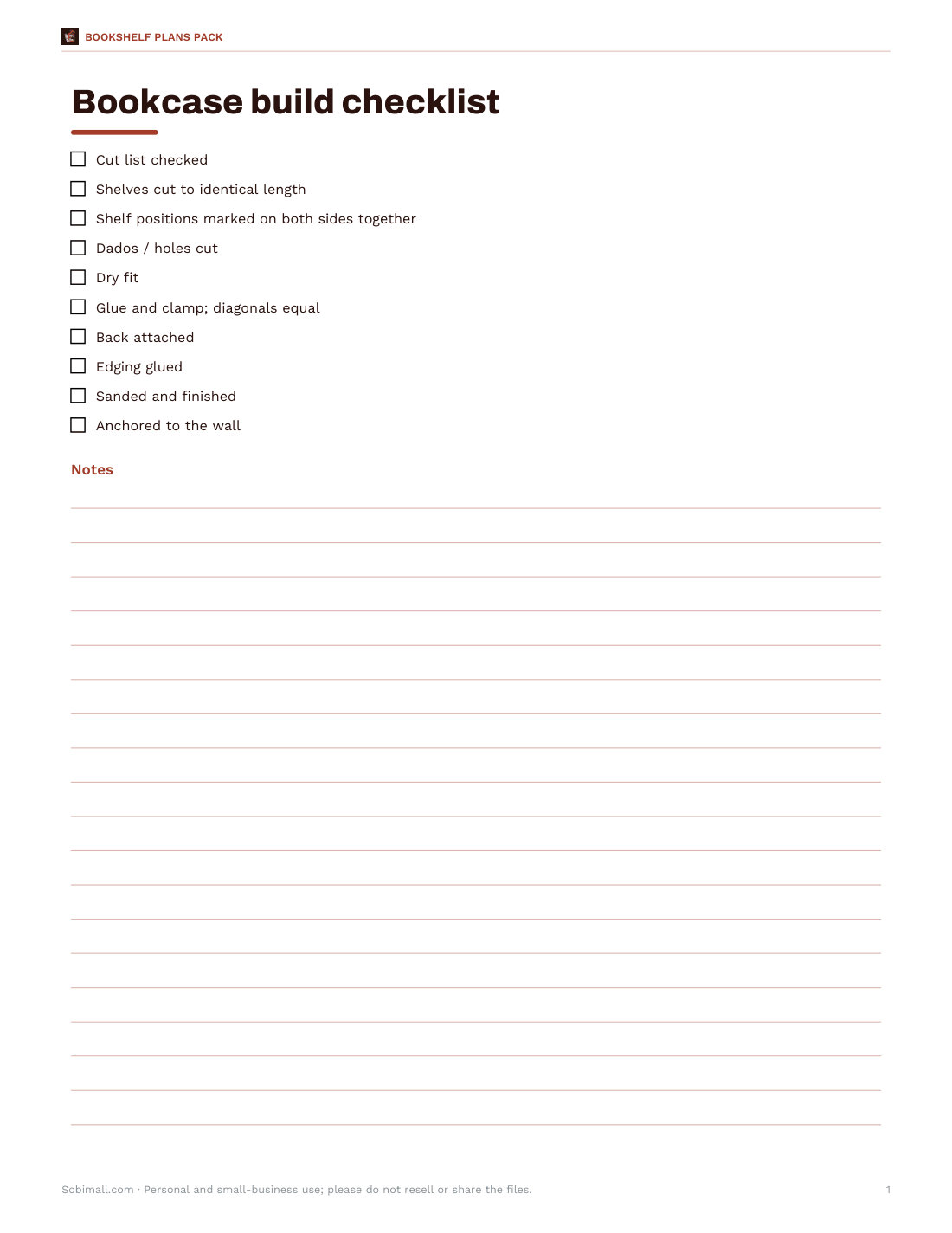
- Build checklist (PDF/DOCX)
- Cut list (XLSX)
Formats: PDF, DOCX, XLSX. Instant download after payment (link valid 72 hours, up to 5 downloads). AI-assisted: the templates were drafted with AI help and reviewed and laid out before publishing.
$7.00 USD, one-time 4 files · about $1.75 each
- Instant download
- 7-day refund
- Secure checkout by Stripe
7-day money-back guarantee. Full refund within 7 days of purchase, even after you download.
Free sample: Bookcase Plans (PDF, 54 KB)
Full refund within 7 days — see the refund policy and license.
Free printables
Single sheets you can print right now, no sign-up. The full pack adds every sheet in one download plus the editable files.
 Printable Bookcase Plans Chart
 Printable Shelf Span Chart
 Printable Bookcase Build Checklist
 Printable Bookcase Cut List Calculator
Standard bookshelf dimensions
| Dimension | Typical | Notes |
|---|---|---|
| Depth | 10–12 in (25–30 cm) | 11¼ in is the width of a nominal 1 × 12 board; paperbacks need only 8 in |
| Shelf spacing | 10–13 in clear | Most hardbacks are 9–11 in tall; art books and binders need 13–15 in |
| Width | 30–36 in per bay | Longer spans need thicker or stiffer shelves |
| Height | 30–84 in | Tall units must be anchored to the wall |
| Material thickness | ¾ in (19 mm) | The usual choice for shelves and sides |
Why shelves sag
A shelf is a beam loaded along its length. Its sag grows with the fourth power of the span, so a shelf 20% longer sags about twice as much. Stiffness depends on the material (oak is stiffer than pine, which is much stiffer than MDF or particleboard) and on the thickness cubed. Books are heavy — a foot of hardbacks can weigh 20 pounds — and wood and wood composites also creep, sagging more over months under constant load. A common aim is sag less than about 1/360 of the span, which is not noticeable to the eye.
Ways to stop sag
- Shorten the span: keep book shelves under about 32–36 in in ¾ in plywood or pine.
- Use a stiffer material: solid hardwood or plywood instead of MDF or particleboard.
- Glue a front edging strip (1–2 in tall) under the front of each shelf — it adds a lot of stiffness.
- Fix the back panel to the shelves with glue and nails.
- Add a middle upright or support for long shelves.
- Use thicker shelves (1 in or doubled ¾ in).
The calculator includes the front edging strip in its stiffness estimate — try changing its height to see the effect.
Worked example
A 72 × 36 × 11¼ inch bookcase in ¾ inch birch plywood with six shelves has an inside span of 34½ inches and about 13½ inches of clear height between shelves. Without edging, a shelf full of heavy books would sag roughly a tenth of an inch over time — just past the point where sag becomes visible. Adding a 1½ inch hardwood edging strip to each shelf front stiffens it enough that the long-term sag falls below the 1/360 guideline. The cut list is two 72-inch sides, six 34½-inch shelves, five edging strips and a ¼-inch plywood back.
Joinery options
| Joint | Strength | Skill and tools |
|---|---|---|
| Butt joint with screws | Adequate for light loads | Drill and screws — beginner |
| Pocket screws | Good | Pocket hole jig — beginner |
| Dado (housing) joint | Very good — shelves sit in grooves | Router or table saw — intermediate |
| Shelf pins (adjustable) | Good for moderate loads | Drilling jig — beginner |
| Biscuits or dowels | Good alignment | Joiner or dowel jig |
Fixed shelves glued into dados, plus a glued-on back, make the stiffest and squarest bookcase.
Build steps
- Cut sides and shelves to the cut list; check that shelves are all exactly the same length.
- Mark shelf positions on both sides together so they line up.
- Cut dados or drill shelf-pin holes.
- Dry-fit, then glue and clamp, checking the diagonals for square.
- Attach the back panel to hold it square.
- Add edging strips, sand and finish.
- Anchor the bookcase to the wall with anti-tip hardware.
Choosing lumber and sheet goods
| Material | Pros | Cons |
|---|---|---|
| Pine boards (1 × 12) | Easy to work, affordable, good for paint | Softer; can dent; boards may cup |
| Hardwood (oak, maple, walnut) | Strong, stiff, beautiful under clear finish | More expensive; harder to cut |
| Birch or hardwood plywood | Stable, wide panels, stiff | Edges need banding or edging strips |
| MDF | Smooth for paint, cheap | Heavy, sags, dislikes water |
| Melamine particleboard | Pre-finished | Sags and chips; limited spans |
Nominal lumber is smaller than its name: a “1 × 12” board is about ¾ × 11¼ inches, which is why 11¼ inches is such a common bookcase depth.
Finishing
Sand to 150–180 grit before paint or stain. For painted bookcases, prime first — plywood and MDF edges soak up paint. Clear finishes such as wipe-on polyurethane protect hardwood and are easy to apply. Let finishes cure fully (often several days) before loading books, or the covers can stick to the shelves.
Safety
Tall bookcases can tip over when climbed or overloaded, which is a serious risk for children. Always anchor tall units to wall studs with anti-tip hardware, load the heaviest books on the lower shelves, and follow tool safety practices when cutting and routing.
The bookshelf plans pack
The optional pack includes printable plans for three bookcases (low, medium and tall), cut lists, a shelf span and sag reference chart, a build checklist and an Excel cut list calculator. The calculator on this page is free.
AI-assisted content
This page was drafted with AI assistance and reviewed before publishing. Sag estimates use simple engineering approximations and typical material values.
Frequently asked questions
How deep should a bookshelf be?
About 10–12 inches for most books.
How far apart should bookshelves be?
Around 10–13 inches of clear height for typical books.
What is the maximum span for a bookshelf?
For ¾ in plywood or pine with heavy books, roughly 30–36 inches, less for MDF.
How do I stop shelves sagging?
Shorten the span, use stiffer material, or add a front edging strip.
What wood is best for bookshelves?
Hardwood or good plywood; avoid long spans in MDF or particleboard.
Should I anchor a bookcase to the wall?
Yes, especially tall units.